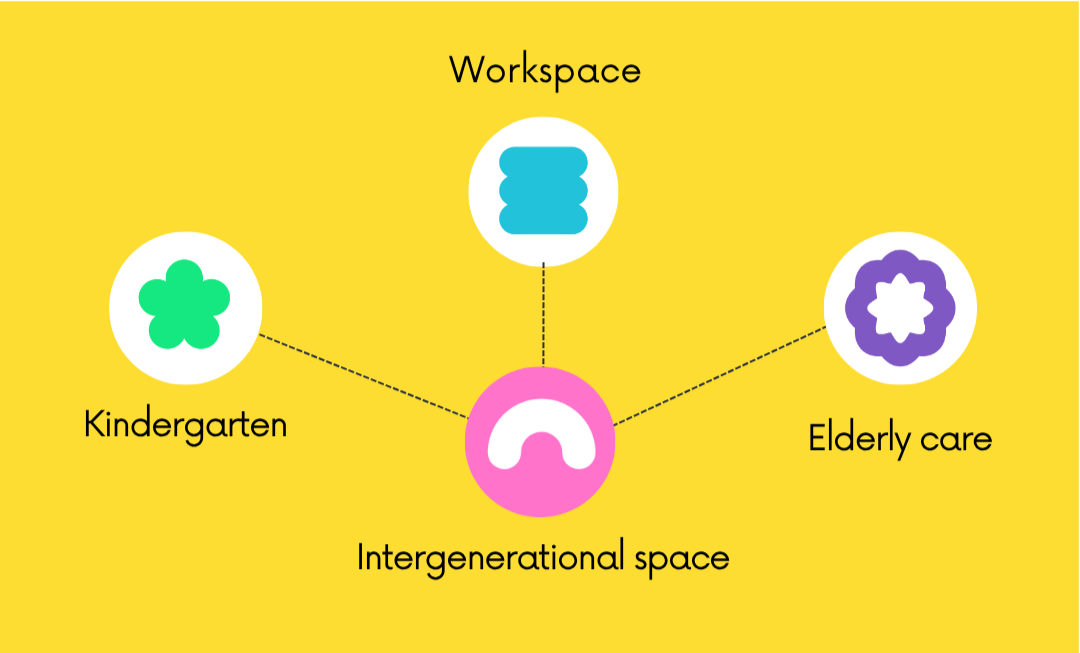
Porto Dome is a design and implementation framework for creating intergenerational workplaces.
It defines how childcare, elder day support, shared spaces and the working day can operate safely and meaningfully within reach of each other.
It is eight in the morning and you have to go to work.
Who is with the people you love?
Care is economic infrastructure
The thing a society cannot function without.
Two floors down. Down the street. Close enough that you see them at lunch.
Europe already runs on it. Unpaid care across the continent is worth around €576 billion a year — roughly 3.6% of EU GDP — and families carry almost all of it.
We maintain the roads. We inspect the bridges. This carries a comparable load, and we have never once designed for it.
We added decades to human life and redesigned none of our workplaces.
One in three working-age Europeans — 106 million people — already carries some responsibility of care.
Care for a parent begins, on average, at 59.6, in the last decade of a working life, when someone is at their most experienced and hardest to replace.
It begins earlier for people whose work is already undervalued.
And it arrives in the middle of the working day.
Childcare. Support for working parents, on site or nearby.
Elder day support. Support for ageing parents within the same daily rhythm.
Intergenerational connection. When children and older adults spend real time together, social isolation drops and perspectives on age change.
That third outcome is not a side effect. It is the entire point, and it only happens when someone designs for it.
A workplace that meets the standard is an Intergenerational Workplace. Porto Dome is what makes those two words mean something.
A co-located care ecosystem
Four generations, one short walk, one ordinary day.
Activating the civic and corporate buildings that already stand.
The measure is the walk.
The same building, or fifteen minutes on foot, near enough that someone crosses between the parts of their own life on an ordinary morning, and is at their desk by half past.
Every part of this already exists.
Childcare exists. Elder day support exists. Workplaces exist.
Intergenerational practice has fifty years of evidence behind it and a WHO guide explaining how to do it well.
What has never existed is all of them in one place, close enough to cross on foot, with a framework holding them together and someone accountable for the quality of what happens between them.
Five elements. Four of them ordinary. The fifth is the one nobody has built.
The building. A workplace, health campus or civic building that already stands reused, not built.
Childcare. Licensed, professional, anchored on nurseries that already exist on site or nearby.
Elder day support. Licensed, professional, in the same building or within the walk.
The shared space, and the practice in it. A courtyard, kitchen, garden or reading room where children and older people meet in designed, facilitated sessions purposeful and mutually beneficial, as the Beth Johnson Foundation defined it.
The standard. The part that does not exist anywhere else, the conditions all four have to meet, and the thing that turns a good intention into a place that works.Who is with the people you love?
Trained staff facilitate every session, and professional carers retain full care responsibility throughout. Elders are never substitute childcare. Children are never entertainment. Everyone is there by choice
Each service keeps its own staff, ratios and safeguarding rules; the shared sessions are planned and facilitated, never unsupervised mixing.
A Tuesday in the first Porto Dome
This building does not exist yet. This is the day it is being designed to make ordinary.
At twenty past eight a ward clerk arrives with her daughter, walks her across the courtyard to the nursery, and is at her desk by half past. It is the only drop-off she has to make.
At half past nine the minibus pulls in and her father comes in with it, as he does three mornings a week. Someone calls his name before he is through the door — there are people in that room he already knows. She goes up to her desk without looking back.
Not because she has stopped checking. Because checking is now a flight of stairs — and so is she, if he ever needs her. She has come down at odd hours, between meetings, and found the room as warm and grounded as when a visitor is expected. That is why he is here, and not across the city: care that can be seen at any moment holds itself naturally to a higher standard.
At eleven the courtyard fills, and for one hour the two rhythms of the building are in the same place on purpose. A man who has said very little this week is showing a five-year-old how to tie a knot he learned at sea.
By four her father is home. She and her daughter leave together at half past five.
Nothing about this day was improvised. She did not drive across a city, and she did not take the morning off.
And what the building got back
Her employer did not organise her family's day. It made a building where that day was possible.
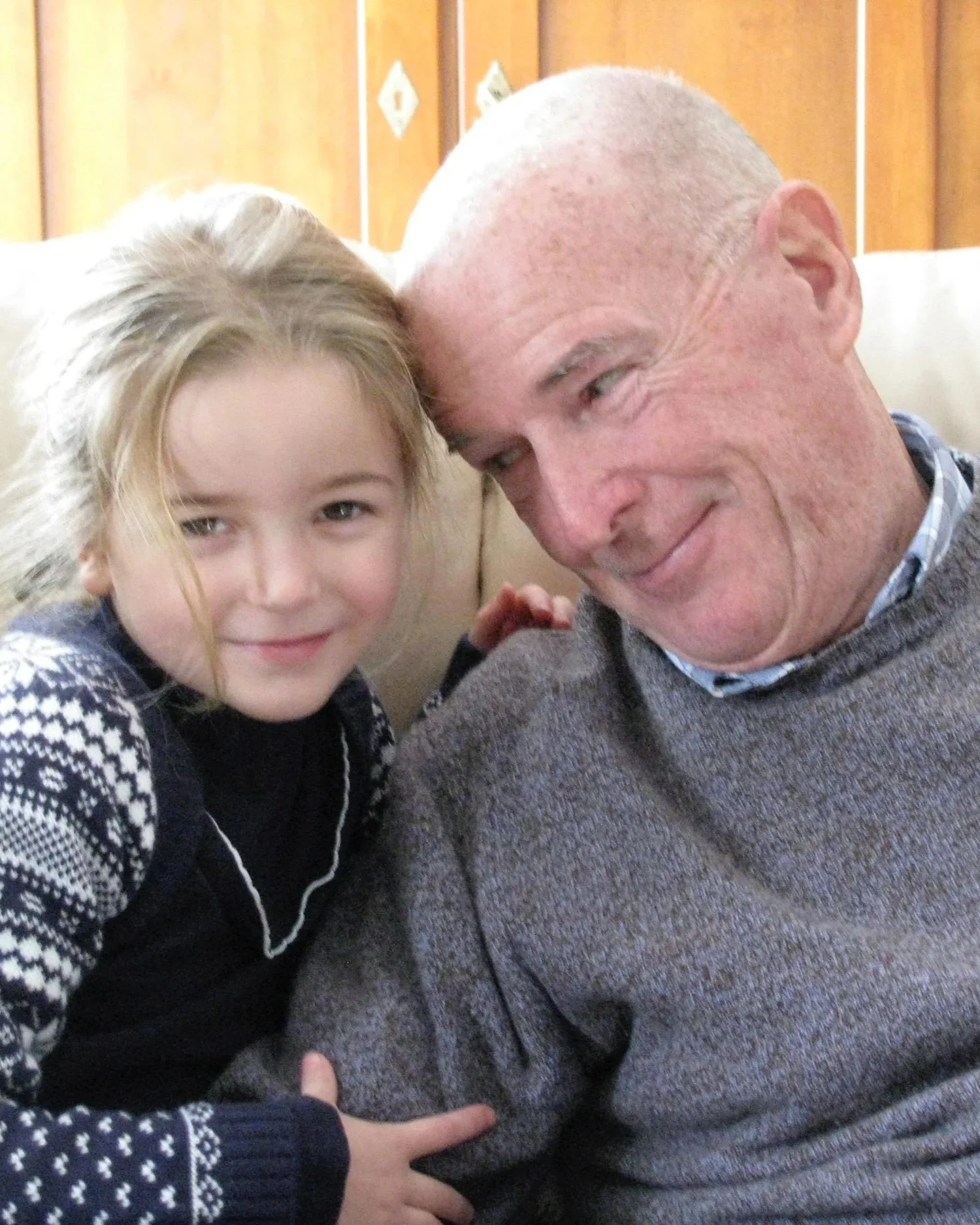
She was in the ten o'clock meeting, and she was actually in it. Nobody covered a shift. She did not spend the afternoon on the phone to an agency, and she is not planning to reduce her hours next year.
When someone asks her what it is like to work here, this is the thing she tells them.
No building like this exists yet. Every condition it would have to meet is written down, and the first one is waiting to be built.
Grounded in research and in fifty years of practice
The challenge
More than 8 million Europeans are kept out of the labour market entirely by unpaid care responsibilities. European Commission, European Care Strategy, 2022
4.1 million Europe's projected shortage of healthcare workers by 2030. European Parliament, 2025
59.6 the average age at which people begin caring for a parent, usually while still in paid work. Earlier for workers in lower-paid occupations. Alonso-Perez et al., Ageing & Society, 2026
Children and older people together is not a new idea.
It has worked for fifty years.
Japan, since 1976. Over a hundred co-located nursery and care home facilities nationwide, starting with Shimada Masaharu's first site in Tokyo.
London, 2017. Apples and Honey Nightingale, the UK's first intergenerational nursery, reserves a fifth of its places for the children of care home staff and reports better recruitment and retention.
Germany, today. Around 530 federally funded Mehrgenerationenhäuser — neighbourhood houses where generations meet by design — with the programme funded to 2028.
The World Health Organization has said so twice: its Global Report on Ageism (2021) named intergenerational contact one of three strategies proven to reduce ageism, and its Connecting Generations guide (2023) set out how to design, run and evaluate that contact.
The evidence is settled. The method is proven. The policy is written. What has been missing is a standard — and a place where all of it meets the working day.
I know what a brief looks like before anything exists. I know what a care home smells like at six in the morning.
I am a licensed architect. For twenty-five years I have built across Europe and Latin America — hospitals, social housing, corporate headquarters, and workplace refurbishments for Telefónica.
It was a sunny summer day in northern Italy.
Next to me sat my father — his hands, once so steady when he ran his business, resting quietly in his lap. He was living with dementia.
A child ran past and jumped on a swing.
Their eyes met. The child smiled. My father smiled back.
That was it. A moment that lasted three seconds. And something clicked.
When care got real, the system gave me two impossible choices: my career, or his care. Not both.
That is when I set out to redesign the workplace itself — not for performance, but for life.
I tutor on the International Certificate in Intergenerational Practice, delivered by Generations Working Together.
What the first one changes
July 2026
The first Intergenerational Workplace will not be a pilot of somebody else's model.
It will be the building everyone else points to.
A city that goes first shows a continent how to use the buildings it already holds.
A care operator that goes first stops losing staff to a problem no salary can solve.
And the children and older people inside it get something no policy has managed to deliver: each other, on an ordinary Tuesday.
That building does not exist yet. That is the invitation.
The framework is drafted, the research is grounded, and conversations with cities and operators are underway — whoever moves next will not be testing the framework. They will be writing it.
WHO Regional Office for Europe (Feb 2027)
Selected from 153 submissions for poster presentation at the Health and Care Workforce Optimization Expo.
Festival of the New European Bauhaus (June 2026)
Care Is Infrastructure convened on 10 June 2026 as an official Satellite Event.
European Care Strategy Alignment (2022) Directly aligned with EU policy calling for care that is accessible at atypical hours and located within easy reach of where people work.
One city. One operator. One health system.
The first of them decides what this becomes.
Start with the building you already hold
If you hold a building, run a care operation, or carry a question worth testing, let us find out together what it could become.
Not a proposal. A conversation about a specific place, and what could happen inside it.